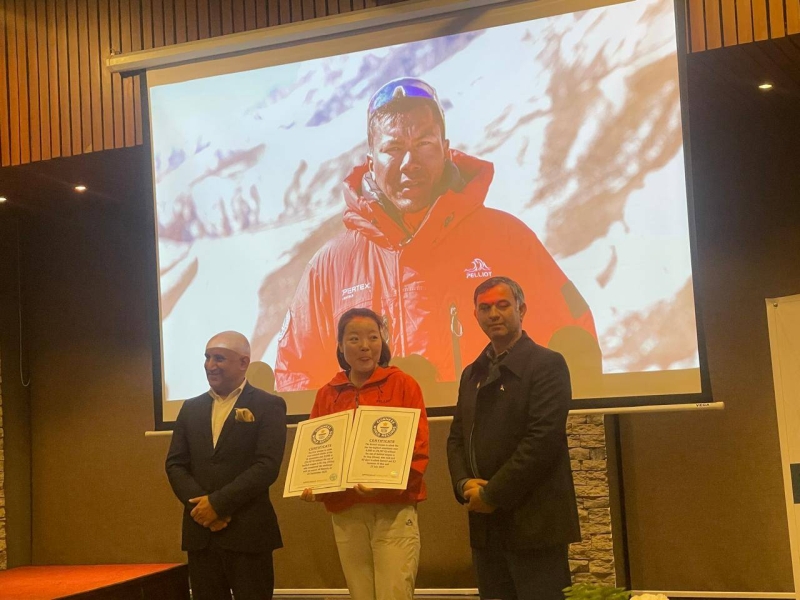
In a momentous ceremony held in Kathmandu on February 14, record-setting Chinese climber He Jing and her Sherpa colleagues were celebrated for their pioneering ascent of two previously untouched peaks in the Western region of Nepal. The event underscored their successful climb during winter, a rarity that adds to the allure of Nepal’s mountainous terrain.
He Jing, already renowned for her extraordinary feats in mountaineering, was presented with Guinness World Record certificates acknowledging her accomplishments. These include becoming the first woman to scale all 14 of the world's eight-thousanders without supplemental oxygen and setting the record for the fastest ascent of Everest to K2 without the aid of bottled oxygen. "I am very grateful for this recognition. Climbing is not just about me; it is about teamwork, and my Sherpa partners made this possible," she stated.
The expedition team consisted of He Jing, IFMGA Guide Dawa Phinjo Lama Bhote, and several guides from Seven Summit Treks, including Ming Temba Sherpa, Phurba Sonam Sherpa, Wangdang Bhote, and Speed Dawa. They successfully summited Jyanglatunpu (6,062m) and Kekyap Ri (6,187m) on February 9. Their achievement is noteworthy within the climbing community, particularly as it highlights Nepal's untapped potential for adventure tourism.

According to Rish Ram Bhandari, an executive member of the Nepal Tourism Board (NTB), the climb symbolizes a significant advancement for the global perception of Nepal’s climbing sector. "This ascent sends a positive message about the potential for growth in our mountain tourism offerings, especially as we look beyond the famous eight-thousanders," Bhandari remarked during the ceremony.
During the expedition, which kicked off on February 4, the team adopted a novel approach. SST emphasized that this climb featured a blend of lightweight, self-sufficient methods with traditional Himalayan mountaineering techniques. He Jing described this climb as distinctly different from her previous endeavors. "For me, it’s very special, a big challenge. When I climbed all 14 eight-thousanders, I did so with major professional support. This time, it was solely our team working together."
She elaborated on the contrasting conditions encountered on both peaks. "On one peak, there was no snow at all, while on the second peak, we faced an abundance of snow. It made the final 100 meters particularly treacherous with a steep mix of rock and snow. It was breathtaking to see Dhaulagiri and Annapurna from up there," she explained. He Jing also credited her sponsor, leading outdoor brand Pelliot, for providing high-quality gear that was crucial for their success.
The expedition was indeed challenging; recent heavy snowfall necessitated a change in the team's planned route. They opted to establish their base camp lower than usual, due to the difficult terrain. Dawa Phinjo Lama Bhote, a guide on the expedition, highlighted the seriousness of their climb. "The navigation was tough—the planned route was unpassable due to snow, and we adapted as required," he noted, comparing the experience to old-school alpine climbing. The team’s collective effort paid off as they initiated the summit push under the stars at 2:25 am on February 9.

While the first peak provided manageable snow, Kekyap Ri required more technical skill, prompting the team to fix ropes along steep sections for safety. The final ascent involved strenuous climbing through rocky ridges requiring a concentrated effort, which took them between 30 to 45 minutes of careful maneuvering to conquer.
Team members expressed optimism about the potential for these peaks to attract future commercial expeditions, believing that such climbs could greatly enrich Nepal's mountaineering appeal. The success of this expedition marks a significant step forward in establishing Nepal as a versatile destination for climbers looking for both challenge and adventure beyond the well-trodden paths of the Himalayas.