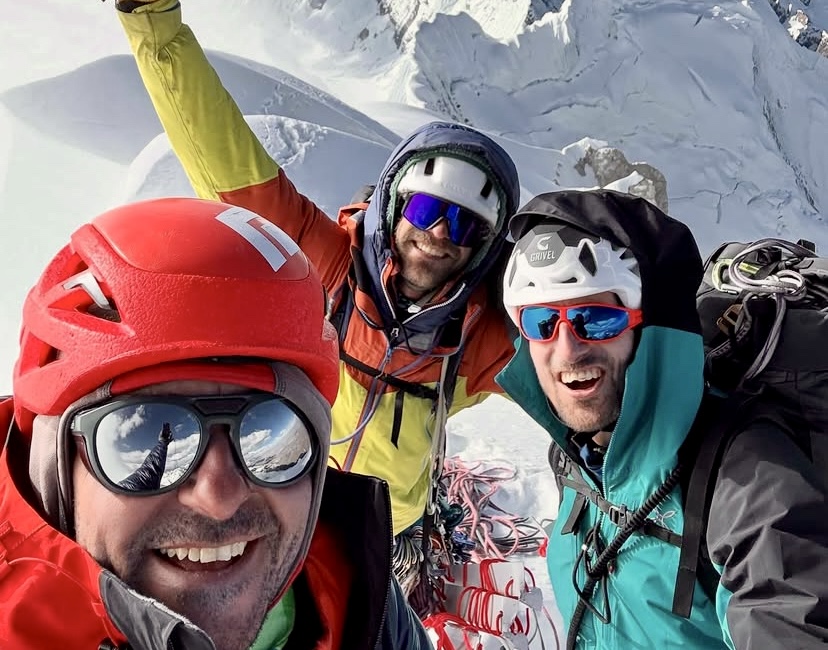
In early August, three climbers showcased remarkable skill and determination by establishing an unprecedented climbing route on Yerupaja, Peru's second-highest peak at 6,634 meters. Marc Toralles, Bru Busom, and Ruben Sanmartin tackled this formidable challenge between August 4 and 9, scaling a 3,000-meter line that ascended the mountain's east face and east ridge, culminating in the first-ever east-to-south traverse of the imposing peak.
"This was more than just a climb; it was an experience of survival and commitment," said Marc Toralles. The team faced a steep limestone wall that presented serious hazards, including falling rock and unstable ice formations, famously known as ice "mushrooms." Just navigating this section felt like a significant achievement.
The climb required full commitment because, as Toralles explained, there was "no option for retreat" on the ridge. With limited visibility and challenging snow conditions, the climbers pushed through, reliant on their skills to safely reach the summit. "We spent four days battling the elements, and each moment was filled with uncertainty," said Ruben Sanmartin, reflecting on the climb’s unforgiving nature.

Upon reaching the summit, they continued their descent via the south ridge, which proved equally demanding. Rappelling through complex terrain was a painstaking process, a testament to the rugged nature of Yerupaja. This aspect made the accomplishment all the more satisfying for the climbers, who also reached a lower sub-summit, marking their traverse as a feat never before documented.
Yerupaja, known as "The Butcher" for its sharply defined ridges and the extreme difficulties it presents, has a sparse yet storied history in climbing circles. Notably, the mountain was first surveyed in 1927 by an expedition under the American Geographic Society, as mentioned in the *American Alpine Journal*.
This mountain has seen climbers drawn by its imposing stature. The first successful ascent of its main summit, Yerupaja Grande, occurred on August 3, 1950, by David Harrah and James Maxwell of the Harvard Andean Expedition. They managed to ascend from the southeast face, though many before them encountered the dictates of the weather and treacherous conditions.
"Climbing Yerupaja Grande felt like stepping into a setting from a different era," said Toralles, elaborating on the legendary status of this mountain which has captured the imaginations of climbers for decades. Notably, Karl Schmidbauer led a failed attempt in 1948 due to adverse weather on the southwest face, and several attempts followed, showcasing the peak's challenging and dangerous environment.

The challenges continued into the later decades. In July 1957, Toni Egger and Siegfried Jungmeier ascended Yerupaja Chico, a sub-summit, by climbing the east ridge. Various Scottish teams in the 1960s, including one led by Malcolm Slesser, found the glacier approaches too perilous to conquer.
Fast forward to July 12, 1966, where Leif Patterson and Jorge Peterek completed the mountain's second ascent by climbing a steep west face over the course of 13 grueling days. The 1968 ascent by Chris Jones and Paul Dix marked the first successful climb of the northeast face, and subsequent attempts have added layers to the mountain’s rich climbing heritage.
On July 4, 2001, Santiago Quintero from Ecuador achieved a daring solo ascent of the west face, marking the last successful attempt prior to the recent expedition. Meanwhile, in 2003, Slovenian climbers opened a route on the northeast face but did not reach the summit, retreating at 6,550 meters during a storm.
The newly established route by Toralles, Busom, and Sanmartin not only adds a remarkable chapter to Yerupaja’s climbing history but also paves the way for future explorers eager to take on its challenges. The commitment, resilience, and pioneering spirit displayed by the team reflect the spirit of climbing itself, a pursuit that continues to inspire adventurers around the globe.