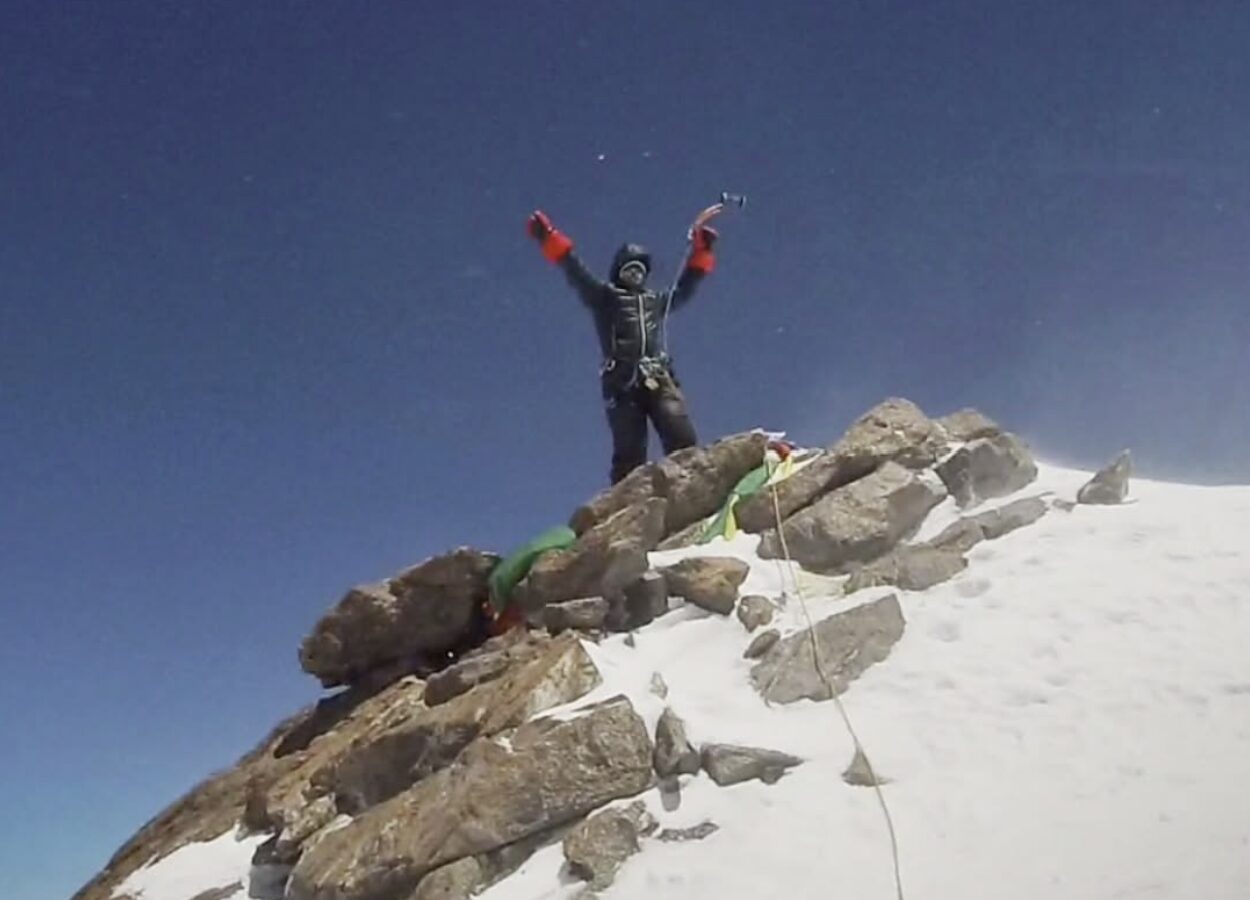
Denis Urubko and Maria Cardell recently divulged critical details about their newly established climbing route on Nanga Parbat, a significant achievement in the world of mountaineering. After scaling the mountain from the Diamir side, the duo opted to extend their stay at Base Camp, savoring the mountain's tranquility before returning to Skardu on July 21.
During this extra week, they celebrated their triumph and shared their experiences with the wider climbing community through social media. "We didn't use other people's ropes or tracks," Urubko mentioned, emphasizing their self-sufficient approach to the climb.
Their ascent, executed between July 6 and July 10, was anything but straightforward. The route involved traversing a variety of terrains, including challenging ice, mixed rock, snow, and a crevassed glacier. Urubko explained the precarious nature of their journey, mentioning, "the route is technically difficult and exposed to avalanches and rockfall in some sections."

Adding to the difficulty were the weather conditions they faced. Unpredictable summer storms plagued their ascent, with winds reportedly reaching speeds of 90 kilometers per hour. "There were no breakdowns, injuries, or illnesses," he reassured, highlighting the effectiveness of their planning and execution.
Their solitary journey on the mountain marked a unique season for Nanga Parbat. While other climbers had summited from the normal route, the couple was the only team tackling the mountain's more challenging aspects during their climb. Urubko noted that the last summits on the standard Kinshoffer route took place on July 3 and 4, while other teams, such as David Goettler and the French climbers Tiphaine Duperier and Boris Langenstein, had completed their climbs via the Rupal side earlier on June 24.
The route has sparked conversations within the climbing community, as some observers pointed out potential similarities to prior routes. Notably, the 2009 ascent by Gerfried Goeschl and Louis Rousseau from Austria and Canada came under scrutiny when Urubko shared a topo of their new line. The two routes intersect at elevations of around 6,600-6,800 meters, with Urubko clarifying, "But [our route] continues along the ridge, while the other team went along the glacier."
Maria Cardell lent her agreement to Urubko's assertions, addressing the concerns of overlap directly. "Our route does not step on the Goeschl/Rousseau route at any section; both lines cross, but then the Austrian-Canadian route continues along the glacier and our line follows the ridge," Cardell stated, reinforcing the unique nature of their endeavor.

Moreover, Cardell revealed that prior communication with Rousseau, before embarking on their expedition, helped them ensure they were well-informed about the 2009 route’s specifics. "For a person not familiar with the terrain, it may look like it is the same line, but the distance between both routes is wide; everything else is speculation," she remarked.
Urubko and Cardell's ambitious achievement is notable not only for its technical challenges but also for its significance for Cardell, who is known as "Pipi." Her background as a ski patroller highlights the specialized skills and experience she brought to this demanding climb.
In the realm of high-altitude climbing, establishing a new route on such a formidable peak as Nanga Parbat is a significant accomplishment, one that showcases not only physical endurance but also strategic planning and a keen understanding of the mountain's unpredictable nature. As Urubko and Cardell reflect on their journey, their details offer both inspiration and insight to the climbing community and beyond.